
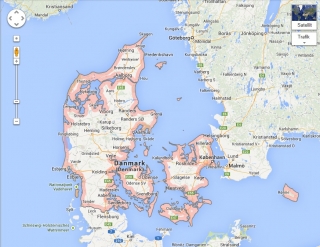
Denmark: must be seen
Copenhagen
Copenhagen is the capital of Denmark with 1.2 million inhabitants and placed at Sealand.
- The Little Mermaid: the famous sculpture of the little mermaid from the fairy tale of H.C. Andersen.
- Amalienborg Palace: the castle of the Royal family.
- Tivoli Gardens: the old amusement park from 1843
- Nyhavn: the old harbour of Copenhagen with colourful narrow houses
- Støget: the main shopping street in the centre of the city.
- Christiania: the famous free town of Copenhagen. Artists go here.
- Canal tour: boats are leaving from Nyhavn all the time, so you can see Copenhagen from the seaside. You will pass by many of the top attractions of Copenhagen and some of the most spetacular architectural building, such as the Black Diamond, the Opera House, the Royal Danish Playhouse, the National Bank and Christiansborg Castle (the national assembly).
- The National Museum: Denmark’s national Museum has exhibitions from the Stone Age, the Viking Age, the Middle Ages, the Renaissance and Modern Danish History.
- Rundetårn: tower and observatory from the 17th century.
- Luisiana Museum of Modern Art: a great art museum located at the seaside. Located north of Copenhagen near Hillerød.
- The Viking Ship Museum: the impressive ships reveal stories about war and raids on trade and travel to distant places, and about life at sea 1000 years ago. Located in Roskilde 30 min. from Copenhagen.
Aarhus
Aarhus is the second largest city. It is a student city because of the university and has the youngest population in Denmark. Located in Jutland.
- ARoS: ARoS is the main art museum in Aarhus and one of the largest museums in Northern Europe. On the roof of ARoS you can also visit Your rainbow panorama from here you can move around in a 150 metre long, circular panoramic path with 360º views of the surrounding city.
- The Old City: a national open air museum of urban history and culture. It is a living and breathing experience of what it was like to live and work in a Danish market town, as it was in the old days.
- Aarhus University Park: ranged in top ten of the most beautiful universities in the world by the Times.
- The Dokk: the harbour area of Aarhus is turning into a new fancy part of the city with great architecture, e.g. the Iceberg.
Third largest city, centered at Funen and mostly known to be the birth place of Hans Christian Andesen.
- The H. C. Andersen Museum: the museum of our famous writer.
- H. C. Andersen’s childhood home: he lived here from he was 2-14 years old.
- Egeskov Castle: one of Europe’s finest Renaissance buildings, featuring a real moat, spires, a knight’s hall and ghastly creatures in its masonry.
- Skagen: At Skagen, the northernmost tip of Denmark, you can walk out onto “the Branch”, a sand spit where the waters of the Kattegat and Skagerrak seas meet. Nearby you can walk on Råbjerg Mile, one of Europe's largest moving sand dunes, over 40 metres high.
- The Wadden Sea: a national park has more than 30 islands and is one of the world's most important habitats for waterfowl. Here you can witness the phenomenal Black Sun, created when tens of thousands of starlings fly together in amazing dark patterns on the sky.
- Møns Klint: the only place in the country where you can experience high chalk cliffs and the unique flora and fauna associated with them.
- Beaches: Denmark has 7,300 km of coastline and really nice beaches.
Castles
- Rosenborg Castle: in the basement you will find the Danish crown jewels.
- · Frederiksborg Palace: situated on three islets in the castle lake in Hillerød, north of Copenhagen. The palace, which is surrounded by the beautiful Frederiksborg Palace Garden, was built in the Dutch Renaissance style at the beginning of the 1600s by King Christian 4.
- Kronborg Castle: one of northern Europe's finest Renaissance castles. Kronborg Castle is probably the most famous Danish castle, known worldwide from Shakespeare's Hamlet.
- Roskilde Festival: the biggest and most well-known of them. This festival is the largest North European culture and music festival and has existed since 1971. Roskilde keywords: beginning of June, 8 days, 130,000 visitors, 160 acts and non-profit organisation.
- NorthSide Festival: the hippest and most popular music festival in Denmark at the moment. The focus is on music, sustainability and innovation. Thus, the festival attracts mostly university students and young entrepreneurs. NorthSide keywords: mid-June, 3 days, 30,000 visitors, 3 stages, hip, sustainable, no camp, within the city, Aarhus.
- Smukfest: the most beautiful music festival in Denmark. The festival is placed outside Skanderborg in a forest with beeches. The festival has a broader scope than Roskilde and NorthSide with a greater variance in music and audience. Smukfest keywords: beginning of August, 4 days, 45,000 visitors, beautiful, in a forest, broad scope.
- Distortion: a street festival with stages and beer booths set up in the streets of Copenhagen. Every day the festival moves to new a part of the city. The street festival is free to attend. Distortion keywords: June, 5 days, Copenhagen, in the streets.
- Grøn Koncert: the annual festival for the good cause of muscular dystrophy. This festival travels through Denmark in the end of July with eight stops in total. The surplus goes directly to the organization of muscular dystrophy in Denmark. At the festival many Danes both with muscular dystrophy and not will be working in the booths to support the good cause. The music programme is broad in scope. Grøn koncert keywords: July, 8 concerts, muscular dystrophy.